My research focuses on the formation and evolution of galaxies, quasars, and large-scale structures in the early Universe, using multi-wavelength observations with JWST, ALMA, VLA, JCMT, Keck, and other facilities. Below I summarize my main research directions.
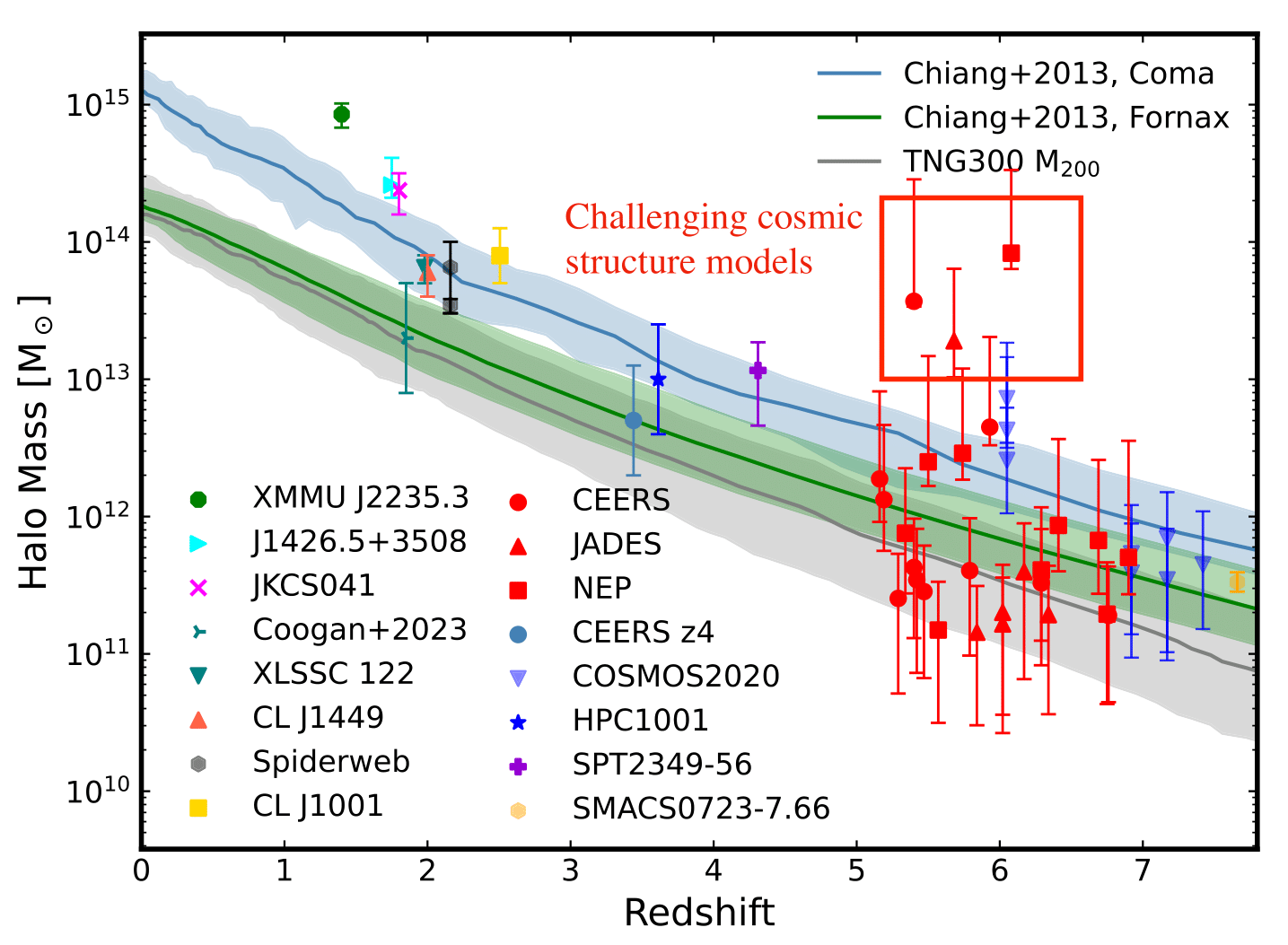
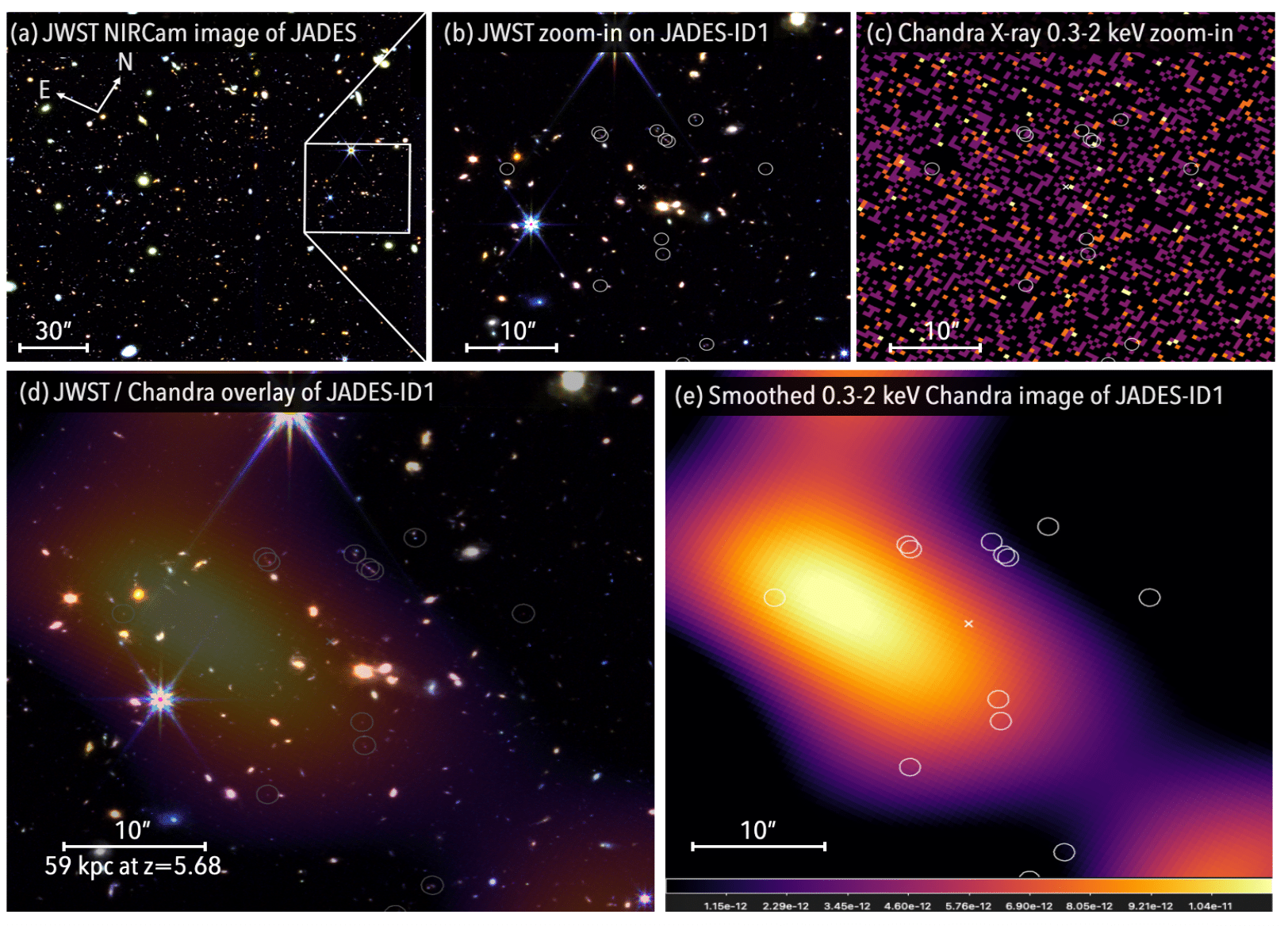
With JWST surveys (CEERS, JADES, PEARLS, COSMOS-Web, etc.), I discovered 26 overdensities at z = 5–7, representing some of the earliest protocluster candidates identified in JWST data. These structures may evolve into clusters with Mhalo > 1014 M☉ by z = 0, challenging models of structure formation. Our discovery of diffuse X-ray emission in a z ≈ 5.5 protocluster, submitted to Nature, suggests clusters began virializing earlier than expected.
I also lead sub-mm surveys with JCMT/SCUBA-2 and VLA to map massive overdense fields at z ≈ 2–3, probing the co-evolution of LAEs, LBGs, SMGs, and AGN within large-scale structures. These studies reveal how cosmic web nodes assembled during the first billion years.
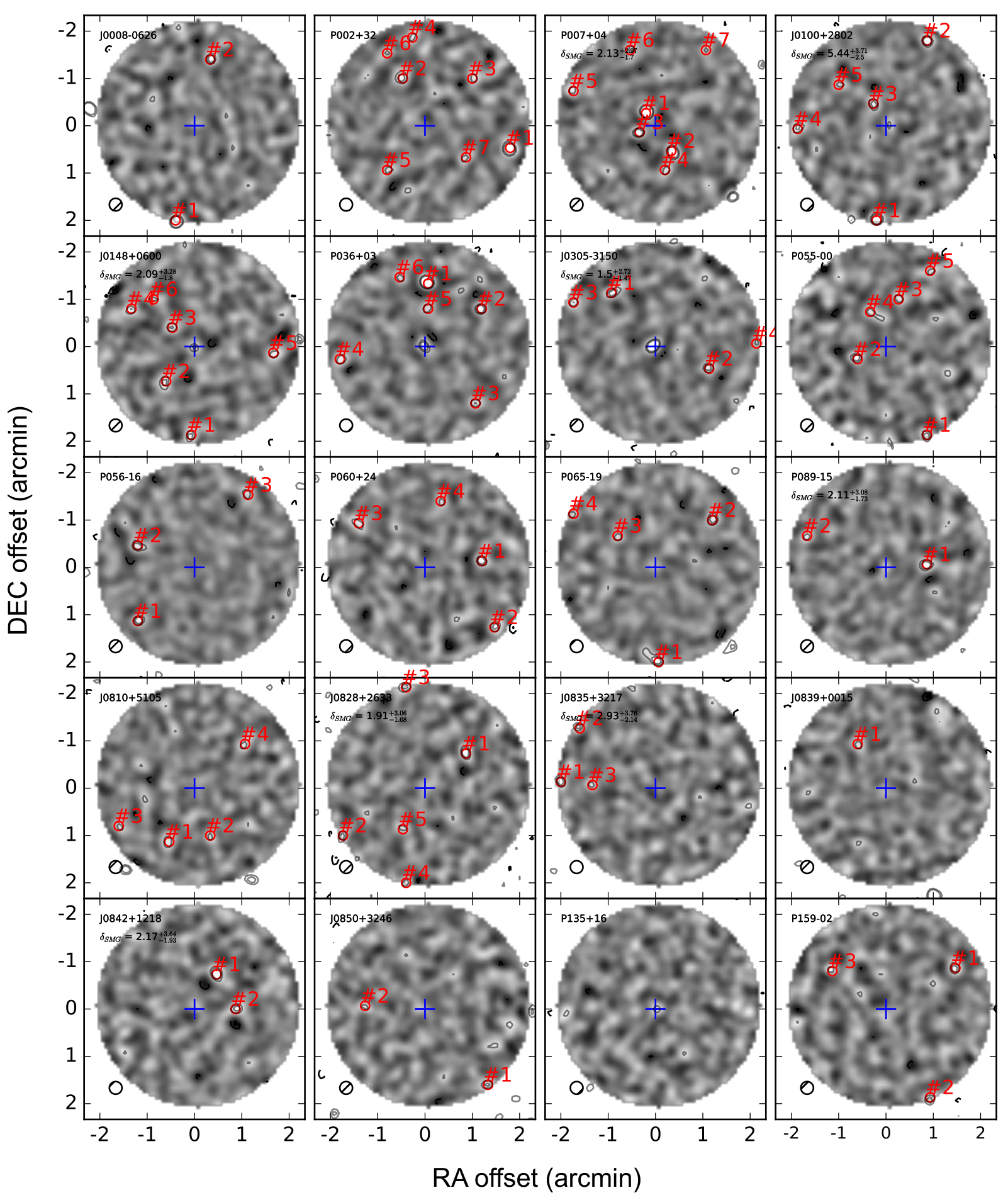
As PI of the JCMT-SCUBA2 SHERRY survey (2016–2018), I built the first statistical sub-mm sample of z ~ 6 quasars (54 objects, 151.5 hours). This survey revealed both their far-infrared properties and evidence of dense protocluster environments. The SHERRY survey is recognized as a flagship achievement of UK sub-mm astronomy.
In addition, I investigate quasar merger rates and AGN activity at z = 4.5–11.5 using JWST, finding that mergers contribute to at least half of galaxy mass growth in the first Gyr. My recent MNRAS work also uncovered new AGN populations such as the “little red dots,” with ALMA follow-up underway.
I have led multiple IFU campaigns with Keck/KCWI and Palomar/CWI targeting Lyα nebulae near quasars, quasar pairs, and WISE Type-II quasars at z ~ 2–3. These efforts discovered:
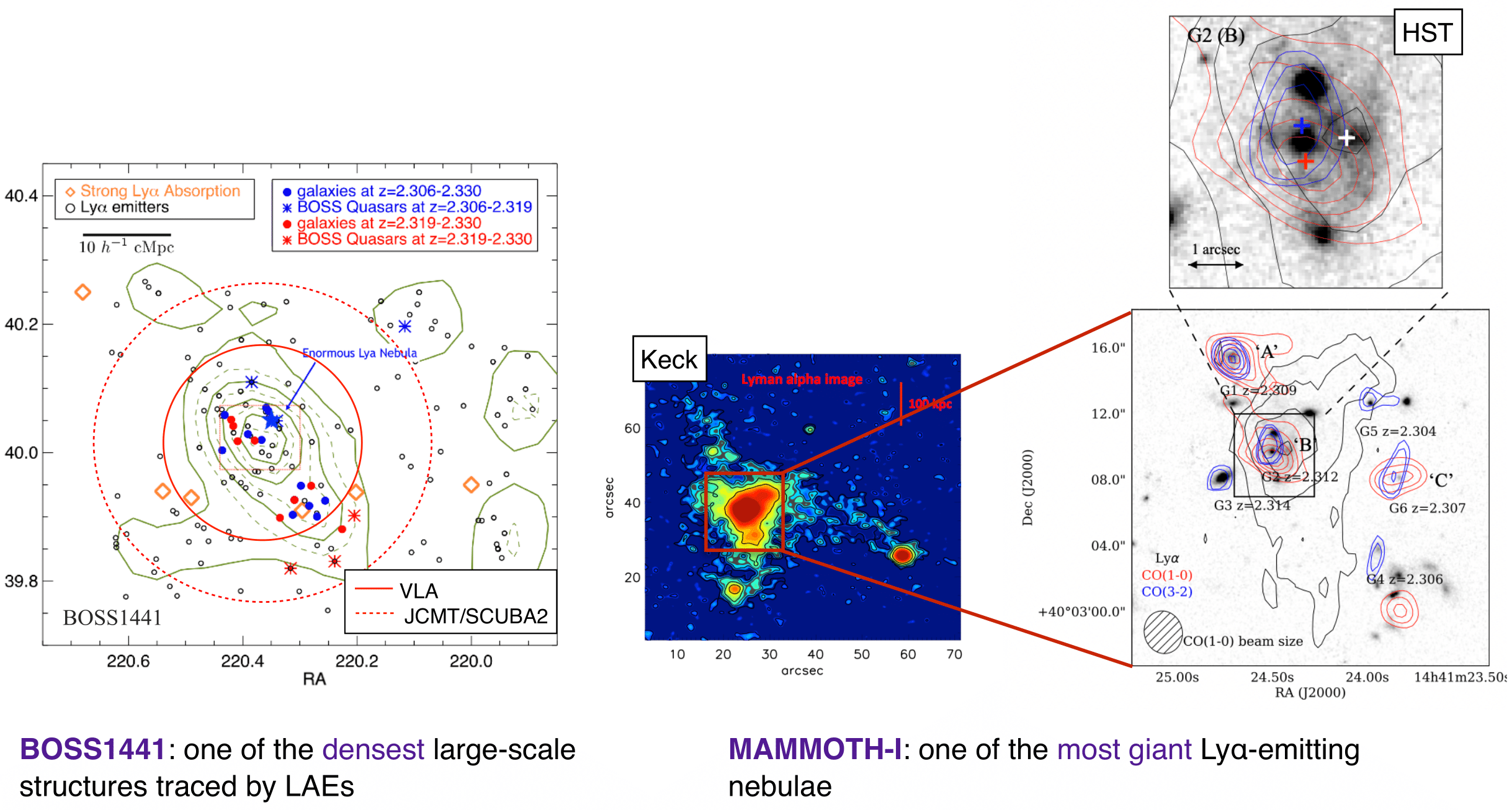
These studies demonstrate how AGN feedback, gas accretion, and metal enrichment shape the multi-phase circumgalactic medium (CGM). Future work with JWST/NIRSpec and ALMA will map emission lines to constrain CGM inflows, outflows, and star-forming gas reservoirs at z > 6.